
Principles are the fundamental truth and system which cannot be avoided in practical field.A sound organization can be stated by keeping in view some basic principles.These principles clarify the philosophy of an organization in a comprehensive way.The major principle are discussed below.
1.Unity of objective:
All the members working in the organization should have the same goals and objectives.
2.Specialization:
Works should be assigned to the individuals on the basis of their skill, knowledge and experience.
3.Co-ordination:
Co-ordination integrates efforts of all the members to meet common goals of organization.
4.Authority and Responsibility:
There must be a balance between authority and responsibility.
5.Unity of Command:
A subordinate should receive instruction from only one individual.So that the given instruction are clearly understood.
6.Scalar chain:
There should be unbroken hierarchy of relationship from top level to subordinate level.This emphasis on the clear instruction from top level to bottom level.
6.Span of Control:
There should be a limited numbers of subordinate under a superior.The number should not more which disturb everyone and maximizes supervision cost.
7.Exception:
only the top priority question should be asked to the superior.The small thing are an exception.
8.Simplicity:
The organization should be simple and easy to understand.
9.Flexibility:
The organization should be flexible so that the changes can be made according to the changing environment.
MEANING AND DEFINITION OF ORGANIZATION
The term "organization" is the second step after planning in the process of management function.Through organization management brings together manpower and other resources for the achievement of organizational goals.It is the backbone and the foundation of the management.It is a formal group of people working together to achieve the predetermined goals of the organization.Here to be noted that the term Organization and Organizing refers to the same concept.This concept of Organization can be studied from two aspects as under.
*As a process-organizing is the process of defining and grouping function and maintaining authority-responsibility relationship among them.
*As a structure-An organization is the structure of relationship among various positionsfrom top level to subordinate level of an enterprise.
*As a process-organizing is the process of defining and grouping function and maintaining authority-responsibility relationship among them.
*As a structure-An organization is the structure of relationship among various positionsfrom top level to subordinate level of an enterprise.

CONSTRAINTS OR LIMITATION OF PLANNING
Planning plays an important role in directing the organizational activity.It is primary and pervasive function. this function of management should be carried out till the end of the organization itself.Despite the many benefits planning has some limitation as well.Some constraints are inherent from planning process and others are associated with planning technique and planners themselves.
*Lack of reliable data
Planning is undertaken on the basis of assumption and certainty of the future.This is not 100% accurate.hence future cannot be accurate since the data are not reliable.Thus planning for future risks uncertainty can give no perfect assurance.
*Time consuming process
The planning process requires a lot of steps and ladders.To overcome all the steps in one step is almost impossible that's why it is a time consuming process.
*Costly process
Since the information to be collected are of high numbers.People have to visit many places and spent resources to collect all the reliable information.Thus it is a costly process.
*Rapid change
Since the management deals about the human behavior and it is difficult to predict the living beings.so the plans set for one time may not be suitable for other time.
*Lack of reliable data
Planning is undertaken on the basis of assumption and certainty of the future.This is not 100% accurate.hence future cannot be accurate since the data are not reliable.Thus planning for future risks uncertainty can give no perfect assurance.
*Time consuming process
The planning process requires a lot of steps and ladders.To overcome all the steps in one step is almost impossible that's why it is a time consuming process.
*Costly process
Since the information to be collected are of high numbers.People have to visit many places and spent resources to collect all the reliable information.Thus it is a costly process.
*Rapid change
Since the management deals about the human behavior and it is difficult to predict the living beings.so the plans set for one time may not be suitable for other time.
BENEFITS OF PLANNING PROCESS IN MANAGEMENT SYSTEM
In business world success of an organization depends solely upon it's capability of looking ahead i.e.planning.Good planning needs better thinking by the manager and it can result in the following benefits.
1.Reduces uncertainty
2.Focus on Goals
3.Economical operation
4.Facilitates control
5.Encourages Innovation and creativity
6.Improves Motivation
7.Ensures better Coordination
8.Avoids Random Activity
9.Improves Competitive strength
All the above benefits can be achieved if the correct plan and policies are implemented in the organization.These can be helpful for the benefit of organizational goals.
1.Reduces uncertainty
2.Focus on Goals
3.Economical operation
4.Facilitates control
5.Encourages Innovation and creativity
6.Improves Motivation
7.Ensures better Coordination
8.Avoids Random Activity
9.Improves Competitive strength
All the above benefits can be achieved if the correct plan and policies are implemented in the organization.These can be helpful for the benefit of organizational goals.
Rational or Need for Planning

Planning helps the management to determine the goals and objective of the enterprise and ways of achieving the goals in the most effective manner.It ensures proper utilization of human resources.Without proper planning the activity of any enterprise are most likely to be haphazard.
As Billy E. Goetz has rightly remarked that "without plans, action will become merely random activity, producing anything but chaos.Thus planning is very essential to achieve consistent and coordinated structure of operation focused on desired goals/objectives.
1.Focuses on Goals:
All planning process is directed towards achieving organizational goals.The planning function brings the manager's attention to focus on the formulation of objective in clear-cut terms.
2.Offsets Uncertainty and Changes:
Planning means looking forward.It helps the organization to overcome potential danger and overcome the adverse effect to a large extent.
3.Economic in Operation:
planning avoids the concept of 'trial and error' or 'hit and miss' or random activities.It selects a course of action which is beneficial from organizational point of view.
4.Avoids Business Failure:
The basic motive of planning is to overcome the probability of business failure.The primary task of planning is to select a best course of action among many alternative.It helps reduce business uncertainty, better coordination, among all the member of the organization, unity of action and so on.Thus planning is the key to business success.
Principle of Management by Henry Fayol
1.Division of work:
This principle implies that every employees should be assigned only one type of work.The objective of division of work is to derive benefit from the principle of specialization.It add to the efficiency of labour.By this principle the, much more production is possible by the same amount of workers.
2.Authority and Responsibility:
The right to give order and power is called authority.On the other hand responsibility means the obligation to perform the assigned work.In any management process delegation of power, utilization of authority, and fixation of authority are the key to success.Authority without responsibility leads to irresponsible behavior while responsibility without authority will make a person ineffective.The success of management solely depends upon parity of authority and responsibility.
3.Discipline:
This principle of Henry Fayol means to obey the decision and the guideline of the superior.This principle is applicable both in management and the subordinate because all are with in the rules of the organization.In fayol view the superior can only expect discipline of subordinate only when they are discipline.
4.Unity of command:
A subordinate must get order from one and only one subordinate.So that he can complete his duties in the best possible way.
5.Unity of Direction:
This principle focuses that there should be one plan and one head for a group of activities having common objective.
6.Subordination of individual interest to general interest:
The first emphasis should be given to general interest rather than individual interest.The achievement of general interest ultimately contributes to the achievement of individual interest.
7.Remuneration of personnel:
The employees should be provided with correct amount of remuneration according to the performance.This makes the employees more loyal to their work.
8.Centralization:
Centralization reduces subordinate's role where as decentralization increases it.According to fayol, managers should retain final responsibility but the subordinate should be given much authority to do their respective jobs.
9.scalar chain: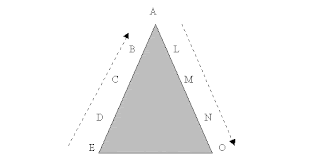
The management hierarchy must flow from top level to lower level.The scalar chain refers to the unbroken relation ranging from top level to lower level.This principle emphasis that the communication must travel from top level to lower ranking official so that every one has the clear concept about the current plans of the organization.
10.Order:
All the resources should be arranged in systematic way.
11.Equity:
Equity is the combination of kindness and justice.Employees expects equity from the management.It ensures healthy industrial relation management and laborwhich is essentialfor the successful working environment.
12.stability of tenure:
Employees must have job security.Frequent changes must be avoided.The moral of the employees will increase if they have job security and ultimately the organization will achieve it's goals.
13.Initiative:
Preferences should be given to the employees to think out plans on their own.
14.Esprit de corps:
This proverb means that "union is strength".It refers that there should be team work in the organization to achieve better result.
This principle implies that every employees should be assigned only one type of work.The objective of division of work is to derive benefit from the principle of specialization.It add to the efficiency of labour.By this principle the, much more production is possible by the same amount of workers.
2.Authority and Responsibility:
The right to give order and power is called authority.On the other hand responsibility means the obligation to perform the assigned work.In any management process delegation of power, utilization of authority, and fixation of authority are the key to success.Authority without responsibility leads to irresponsible behavior while responsibility without authority will make a person ineffective.The success of management solely depends upon parity of authority and responsibility.
3.Discipline:
This principle of Henry Fayol means to obey the decision and the guideline of the superior.This principle is applicable both in management and the subordinate because all are with in the rules of the organization.In fayol view the superior can only expect discipline of subordinate only when they are discipline.
4.Unity of command:
A subordinate must get order from one and only one subordinate.So that he can complete his duties in the best possible way.
5.Unity of Direction:
This principle focuses that there should be one plan and one head for a group of activities having common objective.
6.Subordination of individual interest to general interest:
The first emphasis should be given to general interest rather than individual interest.The achievement of general interest ultimately contributes to the achievement of individual interest.
7.Remuneration of personnel:
The employees should be provided with correct amount of remuneration according to the performance.This makes the employees more loyal to their work.
8.Centralization:
Centralization reduces subordinate's role where as decentralization increases it.According to fayol, managers should retain final responsibility but the subordinate should be given much authority to do their respective jobs.
9.scalar chain:

The management hierarchy must flow from top level to lower level.The scalar chain refers to the unbroken relation ranging from top level to lower level.This principle emphasis that the communication must travel from top level to lower ranking official so that every one has the clear concept about the current plans of the organization.
10.Order:
All the resources should be arranged in systematic way.
11.Equity:
Equity is the combination of kindness and justice.Employees expects equity from the management.It ensures healthy industrial relation management and laborwhich is essentialfor the successful working environment.
12.stability of tenure:
Employees must have job security.Frequent changes must be avoided.The moral of the employees will increase if they have job security and ultimately the organization will achieve it's goals.
13.Initiative:
Preferences should be given to the employees to think out plans on their own.
14.Esprit de corps:
This proverb means that "union is strength".It refers that there should be team work in the organization to achieve better result.
Description to Henry Fayol-Principle of Management

Henry Fayol (1841-1925) was a french industrialist.He joined french mining company in 1860 as an engineerand later became managing director in 1888.In 1916, he published a book known as "Administration Industrielle Generate".Henry Fayol's book was translated into english in 1929as "General and Industrial Administration".He has suggested 14 different principle of management.


