FUNCTIONAL ORGANIZATION:STRUCTURE OF ORGANIZATION

F.W.Taylor, the father of scientific management, has initiated the concept of functional organization under the scheme of functional foremanship.Present functional organization is very much based on the philosophy of functional foremanship scheme.however , in practical, functional organization concept is limited only to the top level management and not in practical at subodinate level.
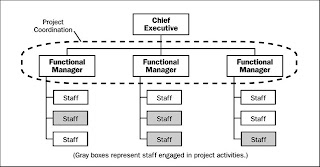
In functional organization, all the business activity of an enterprise are divided into a number of function and each function is entrusted to a specialist.Each specialist, to whom a function is entrusted , is known as functional specialistand authority delegated to each specialist is known as functional authority.For instance, the business activity of an enterprise might be divide into various functions like-production, perssonnel, marketing, finance, research and development,purchasing etc.
Generally, in functional organization the functional specialist communicates with each other through general manager .Here no functional specialist can providedirect instruction or suggestion to another functional specialist.


FUNCTIONAL ORGANIZATION:STRUCTURE OF ORGANIZATION

LINE AND STAFF ORGANIZATION:STRUCTURE OF ORGANIZATION IN MANAGEMENT

line and staff organization us the positive outcome of both functional and line organization.Line organization is the simple pattern of structure which lacks managerial specialization.And , functional organization creates complexity in operation due to unavailability of defined relationship between superior and subordinates.Line and staff is made is make a balance between unity of command and functional specialization.Under this organization there is a provision of chain of command as in the line organization, beside their is a provision of functional specialist to provide suggestion and guidence to the line manager in important matters.The functional specialist are concerned with giving instruction only and don't have the authority to give instruction to the line manager.So the work ofthe organization are divided into two: line and staff.The staff are responsible for the preparation of plans and line authority are responsible for implementation of plans and policy made by the staff.


"line refers to those position and elements of the organization which have the responsibility and authority and are accountable for the accomplishment of primary objectives.staff means to those element which have responsibility and authority for providing advice and service to the line in attainment of objective."
-Louis A.Allen
LINE AND STAFF ORGANIZATION:STRUCTURE OF ORGANIZATION IN MANAGEMENT


Thus line and staff organization is the combination of line and functional organization.This structure is suitable for medium and large scale organization.

GROUP DISCUSSION

GROUP DISCUSSION
Group discussion have now become a sine qua non in various selection procedure. Whether it is recruitment in prestigious firm or admission in the MBA institute, aspiring candidates have to go through the rigors of the group discussion.

*what exactly is a group discussion?

Normally in a group discussion a leaderless group of 8-10 candidates is formed, and is given specific situation to analyze and discuss within a given time limit. The number of participants and the time limit given for discussions vary from situation to situation. A panel of moderates observers and evaluates them during the course of the discussions. Broadly, the moderators assess the candidates of the following points:

  1. command over spoken English
  2. communication skills
  3. knowledge
  4. convincing ability
  5. interpersonal skills
  6. problem solving skills
  7. conceptualizing skills
  8. leadership skills
  9. body language
  10. maturity
  11. creativity
  12. confidence
  13. assertiveness
  14. team spirit and,
  15. ability to take initiatives.
In order to succeed at any group discussions, you must be perceive as having contributed meaningfully to the discussions. Also, you must appear to be a team player and not a self-centered go-getter.

The key words here are 'perceived' and 'appear'. Always remember it does not matter how you rate your performance. What counts are the moderators' rating of it. Keeping this simple fact in mind will help you tremendously in focusing on your performance. You will not be able to use excuses like "I was legitimate in losing my temper as I was provoked".

A meaningful contribution implies that you have a thorough understanding of the topic and related issues, are able to structure arguments logically and are a good communicator. Also everybody can state the obvious. Be sure to bring in diverse dimensions to the topic so that your contributions leave a mark upon the moderators. To come across as a team player you have to listen to others' point of view and encourage a healthy exchange of ideas. You must carry people with you. So do not get emotional, do not shout, nor get into petty fights. If you have spoken and you notice that someone else has tried to enter the discussion on a number of occasions and has not had the chance to do so maybe you could give him a chance the next time he tries.

Your understanding of the topic, which in turn is determined by your reading habits, influences what you speak in the group discussion. If you are well read on diverse areas then coming up with good content will not be a problem. However, if you are not in the habit of reading newspapers then at least be prepared with "current issues in the press" for the group discussion. If you are applying for a job or to a specialized college chances are that your group discussion topic will focus on the your specialization or education. Be prepared accordingly.

You should initiate the group discussion i.e. be the first to speak , only if you have understood the topic clearly. Do not work under the assumptions that if you don't initiate - you lose points. On the contrary if you initiate badly you come under the negative focus of the moderator and suffer consequently.

One common complaint of many group discussion participants is that they did not get a chance to speak. The fact of the matter is that in no group discussion do you get a chance to speak. You have to create your chances. Also a widespread misconception among students is that only the "Leader" gets selected. This makes them commit the mistake of appointing themselves as a de facto leader of the group. You must never try to impose a system whereby everyone gets a chance to speak in turn. A group discussion is meant to be a free flowing discussion. Let it proceed naturally.

For cracking the group discussion one should be at your natural self and avoid putting on a show for the moderators.

The score you receive depends both on 'what' you say and 'how' you say it. Your gestures and mannerisms are more likely to reflect your attitude than what you say. One should be assertive and not dominating apart from being patient and one should also not lose his/her cool. Also, never get involved in one to one discussions with any participants. Bring in as many diverse aspects as you can to the discussion. Always be polite. Try to use phrases like :'I would like to share my views on........' or Yes' , I agree,but.If you have understood the topic in the correct light then do initiate the GD.Always address everyone in the group.

  • Never be hesitant to speak if other are speaking.remember, you never interrupt anyone in the Gd-you must enter it.
  • Never argue with anyone in the group members.
  • Maintain eye contact with maximum members of the group as possible.
  • Never change your stand on any issue during the group discussion.
  • Keep your entire brief and to the stand.
  • Finally, practice makes perfect.Mock GD sessions go a long way in improving your performance and confidence.


INTRODUCTION TO LINE ORGANIZATION STRUCTURE

Line or scalar is the oldest form of organization structure.It is known as military organization.Under this structure there is a direct line of authority from top level to bottom level through unbroken chain.In other words, all the managers have direct supervision over their respective subordinate through chain of command.It means that each subordinate level employee is responsible to his immediate superior or boss.
According to McFarland,"line consist of direct vertical relationships, which connect to the position and task of each level with those above and below it."


LINE ORGANIZATION STRUCTURE

Types of Organization

The types of organizational structure focuses on the creation of different departments and section on the basis of nature of work.It also focuses on the division of work and examines the nature of authority and responsibility within the organization.However the types of organization depends on the nature and the size of the organization.It may vary from enterprise to enterprise.The following are the important types of organizational structure.

1.LINE ORGANIZATION STRUCTURE:
In this structure, there is a direct relationship from top level to bottom level through unbroken chain.

2.FUNCTIONAL ORGANIZATIONAL STRUCTURE:
All business activity of an enterprise are divided into a number of function and each function is entrusted to a specialist.

3.LINE AND STAFF ORGANIZATION:
In this structure, there is a provision of chain of commands,and besides, there is the provision of functional specialist to provide suggestion to the line managers in decision making.

Principles of Organization:Management

Principles are the fundamental truth and system which cannot be avoided in practical field.A sound organization can be stated by keeping in view some basic principles.These principles clarify the philosophy of an organization in a comprehensive way.The major principle are discussed below.

1.Unity of objective:
All the members working in the organization should have the same goals and objectives.
2.Specialization:
Works should be assigned to the individuals on the basis of their skill, knowledge and experience.
3.Co-ordination:
Co-ordination integrates efforts of all the members to meet common goals of organization.
4.Authority and Responsibility:
There must be a balance between authority and responsibility.
5.Unity of Command:
A subordinate should receive instruction from only one individual.So that the given instruction are clearly understood.
6.Scalar chain:
There should be unbroken hierarchy of relationship from top level to subordinate level.This emphasis on the clear instruction from top level to bottom level.
6.Span of Control:
There should be a limited numbers of subordinate under a superior.The number should not more which disturb everyone and maximizes supervision cost.
7.Exception:
only the top priority question should be asked to the superior.The small thing are an exception.
8.Simplicity:
The organization should be simple and easy to understand.
9.Flexibility:
The organization should be flexible so that the changes can be made according to the changing environment.

MEANING AND DEFINITION OF ORGANIZATION

The term "organization" is the second step after planning in the process of management function.Through organization management brings together manpower and other resources for the achievement of organizational goals.It is the backbone and the foundation of the management.It is a formal group of people working together to achieve the predetermined goals of the organization.Here to be noted that the term Organization and Organizing refers to the same concept.This concept of Organization can be studied from two aspects as under.
*As a process-organizing is the process of defining and grouping function and maintaining authority-responsibility relationship among them.
*As a structure-An organization is the structure of relationship among various positionsfrom top level to subordinate level of an enterprise.
 
Home | Gallery | Tutorials | Freebies | About Us | Contact Us

Copyright © 2009 Office Management |Designed by Templatemo |Converted to blogger by BloggerThemes.Net

Usage Rights

DesignBlog BloggerTheme comes under a Creative Commons License.This template is free of charge to create a personal blog.You can make changes to the templates to suit your needs.But You must keep the footer links Intact.